Risk scores for readmission, sepsis, deterioration or medication harm are some of the most requested clinical AI projects. They are also among the easiest to get wrong. A model trained on one hospital's data, evaluated on a random split of the same data, and published with a strong AUC, often performs noticeably worse somewhere else, or even in the same hospital a year later.
The OHDSI community has spent years building a standard way to do this better. Its approach is useful even if you never touch the OHDSI tools.
The problem with most prediction models
The Book of OHDSI is direct about it: many published patient-level prediction efforts don't follow model development guidelines, fail to perform extensive external validation, or provide too few details for others to reproduce and validate them1. It points to the TRIPOD reporting guideline as a standard for transparent reporting14.
The underlying issue is that a model learns the habits of the data it was trained on: coding practices, patient mix, documentation patterns. Those don't travel.
Define the problem precisely
OHDSI frames every prediction problem in the same form: among a target cohort, who will go on to have an outcome within a time-at-risk? Prediction happens at a defined moment, and only information from the observation window before that moment may be used1.
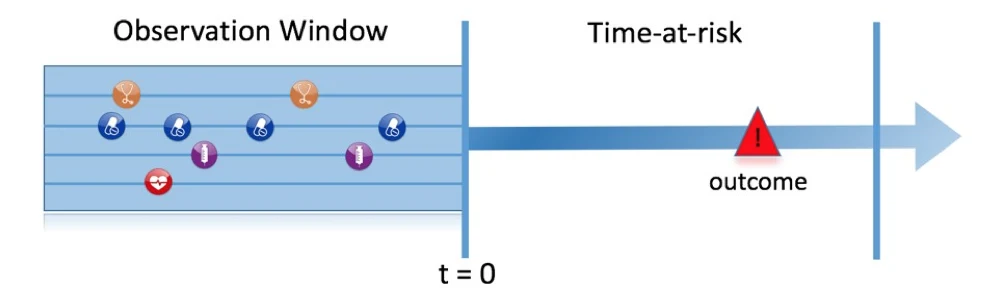
The same template covers disease onset, treatment response, safety and adherence. The book's examples include predicting ischaemic stroke among newly diagnosed atrial fibrillation patients, and gastrointestinal bleeding among new users of warfarin1. Because target and outcome are standard cohort definitions, another site can rebuild exactly the same problem on its own data.
Most prediction projects fail at the first step: an ambiguous index date. If you can't say precisely when the prediction is made, you can't validate it anywhere else.
Measure the right things
Discrimination, usually summarised by the area under the ROC curve, measures whether the model ranks patients who will have the outcome above those who won't. The book notes that for rare outcomes even a model with a high AUC may not be practical, because many false positives can accompany each true one1.
Calibration measures whether predicted risks match reality: of a hundred patients given a 10% risk, about ten should have the outcome1. In the book's worked example, a model was well calibrated overall but poorly calibrated for younger patients1. Overall metrics hide that kind of problem, which is why subgroup checks matter for both safety and fairness.
Validate externally, always
The book distinguishes internal validation, testing on held-out data from the same database, from external validation, developing in one database and evaluating in another. It recommends always performing external validation on as many new datasets as feasible, because different databases represent different populations, health systems and data capture1.
This is where a common data model pays off. A model built on OMOP can be shared as a package and evaluated at other OMOP sites without moving patient data, which is the federated approach described in federated health analytics. The PatientLevelPrediction R package implements this end to end, from data extraction with standard covariates to training and validation23.
How I'd run a clinical prediction project
- Write the prediction question in the standard form and agree it with clinicians before touching data.
- Build cohorts on OMOP, checked with data quality tools, so the design is portable.
- Start with simple models. Regularised logistic regression is often competitive and easier to explain.
- Report discrimination and calibration, overall and by key subgroups, following TRIPOD.
- Validate on at least one external dataset before any clinical use.
- Plan deployment and monitoring: how the score reaches clinicians, how drift is detected, and how changes are controlled. The transparency practices in HTI-1 to HTI-5 and FDA PCCPs apply.
How I can help
I design OMOP-based platforms and clinical AI pipelines that make prediction models reproducible, externally validated and safe to deploy. See healthcare data architecture, or analyse your challenge and bring the result to a call.
- 1
- 2
- 3
- 4TRIPOD statementEQUATOR Network