- Technician access to customer environments through one identity provider, time-limited and recorded
- Standing administrator credentials removed from scripts and tools
- An incident process that can produce an early notification quickly and a full report after
- Affected customers identified and notified from a single source of truth
- Controls mapped to the NCSC Cyber Assessment Framework
Anonymised composite. Client names, identifying details and confidential figures are withheld; public facts are cited in the references.
The situation
A UK managed service provider looked after IT for several hundred organisations: small businesses, schools, professional services firms and a few public-sector suppliers. Its technicians held administrator access to customer networks, cloud tenants and line-of-business systems. Over the years, access had accumulated in shared accounts, remote management tools and scripts with stored credentials.
Why now. The Cyber Security and Resilience Bill would bring medium and large managed service providers within the scope of the NIS regulations, because of the privileged access they hold to customer systems12. It also proposes duties to report significant incidents and to identify and notify customers likely to be affected3. In October 2026 the Bill was still before Parliament4, but the direction was clear, and customers were already asking about it in renewals.
What had to be true
- No standing administrator access to customer environments.
- Every privileged session attributable to a named technician, approved and recorded.
- Incidents detected and escalated fast, with a process that can support early notification and a fuller report.
- Affected customers identifiable within minutes, not days of spreadsheet work.
- Automation under the same rules as people, including AI-assisted tools.
Architecture
The data flow, end to end
- RequestA technician asks for access to a customer system for a ticket
- ApproveTime-limited elevation approved against the ticket
- ConnectAccess through the broker; the session is recorded
- DetectAnomalies in tools or tenants open an incident automatically
- AssessThe impact map lists affected customers and services
- NotifyEarly notifications sent, followed by a fuller report
The hard part: one front door for hundreds of environments
Access was spread across per-customer accounts in dozens of tools, each with its own login and its own way of revoking access. The design moved to a single identity provider for all technician and automation access, with customers' systems trusting it for scoped, time-limited sessions. The same principle is spreading in AI tooling: the Model Context Protocol's Enterprise-Managed Authorization lets an organisation provision access to many servers through its identity provider, scoped to users' groups and roles, instead of authenticating to each one separately6.
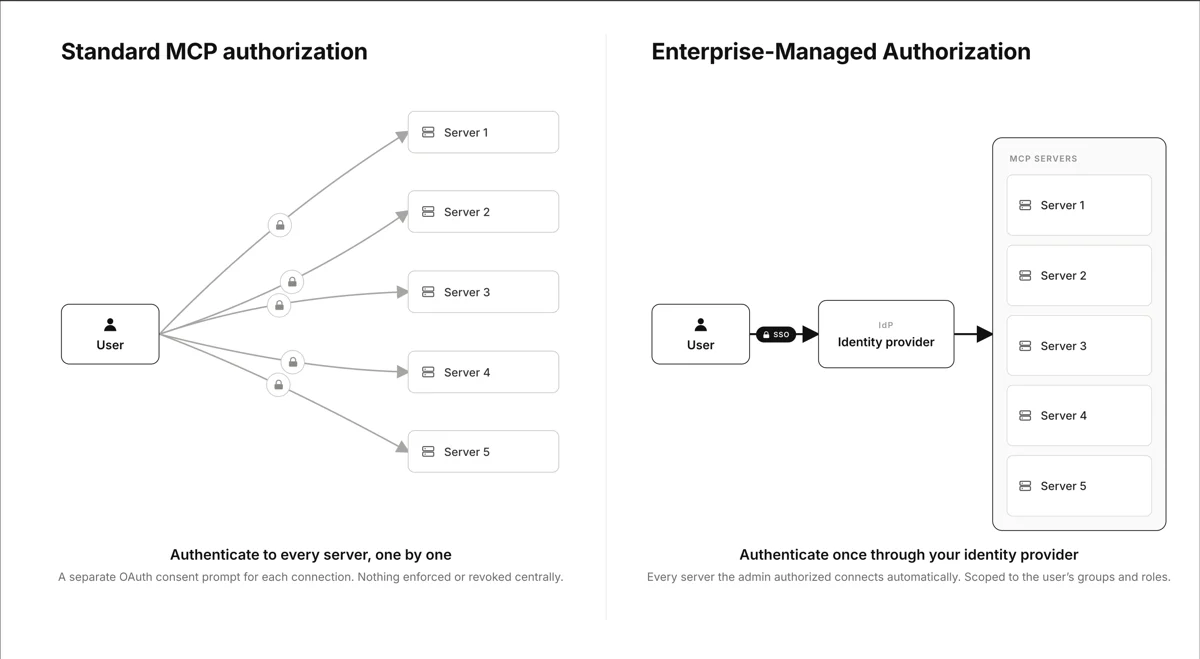
An MSP's biggest risk is its own access. Make every privileged session temporary, attributable and recorded, and most of the regulatory work follows.
Automation got no exemption. Scripts and AI-assisted tools used scoped service identities through the same broker, with no stored administrator passwords. More on that in securing MCP servers and sandboxing AI agents.
How it ran
- Privileged access inventory
- Broker and recording
- CAF mapping
- Ticket-linked access
- Technician training
- Incident drills
- Customer impact map
- Notification templates
- Contract updates
- Every privileged account
- Every remote tool
- Customer to tool map
- Identity provider
- Privileged access broker
- Remove shared credentials
- Event pipeline
- Incident case management
- Reporting timelines
- Notification drills
- CAF assessment
- Customer assurance pack
Controls were mapped to the NCSC Cyber Assessment Framework, which organises security into outcomes for managing risk, protecting against attack, detecting events and minimising impact5. That gave customers and, later, a regulator a recognised way to read the programme.
Key decisions and trade-offs
| Decision | Alternative | Why |
|---|---|---|
| Prepare before the Bill passes | Wait for the final text | The core controls are good practice either way, and customers were asking now |
| Just-in-time access only | Standing admin accounts with strong passwords | No standing access means less to steal |
| One identity provider for people and automation | Per-tool accounts | Central revocation and a single audit trail |
| Customer impact map as a system | Spreadsheets | Prompt notification needs answers in minutes |
| Map to the NCSC CAF | A home-grown checklist | A recognised framework customers and regulators understand |
What I'd do again, and differently
Again: start with the privileged access inventory, because it surfaced most of the risk. Differently: run the first notification drill earlier. It showed that knowing which customers were affected was harder than detecting the incident. Related reading: defender-first AI and patch cycles and an AI copilot for the security operations centre.
If you run or rely on managed services in the UK, my work with UK companies explains how I approach it, or analyse your challenge and bring the result to a call.
- 1
- 2Cyber Security and Resilience (Network and Information Systems) Bill issued by UK governmentClifford Chance · Nov 2025
- 3The UK's new Cyber Security and Resilience BillTravers Smith
- 4Cyber Security and Resilience Bill: are you in scope for 2026?Servnet · Oct 2026
- 5Cyber Assessment FrameworkNational Cyber Security Centre
- 6Enterprise-Managed Authorization: zero-touch OAuth for MCPModel Context Protocol blog (Paul Carleton) · 18 Jun 2026