What changed
Anthropic made its managed Claude Platform generally available on Google Cloud on 22 October 2026: Google Cloud customers can use the full platform with Google Cloud IAM credentials, billing and commitment retirement1. Coverage notes that new platform features arrive on the same day as Anthropic's own API34, that Anthropic is the data processor for this option while Google remains the processor for the existing Google-managed option, and that it launched with US and global endpoints2.
Why the route matters, not just the model
For a long time the choice was "which model". Now, for the same model, the route you buy it through changes several things leaders care about: which company processes your data under contract, which regions are available, how quickly new capabilities reach your teams, and which commitments the spend counts against.
How to decide
- ClassifyWhich workloads touch personal or regulated data, and where
- ProcessorWhich company may process that data under your contracts
- RegionWhether the route offers the endpoints your rules require
- FeaturesWhether same-day access matters for this workload
- CommercialsCommitments, discounts and billing consolidation
- RouteConfigure per workload in the gateway, and review quarterly
| Question | Why it matters | Where it bites |
|---|---|---|
| Who is the data processor? | Determines contracts, audits and sub-processor lists | Regulated sectors everywhere |
| Which endpoints are offered? | Residency rules may require specific regions | EU, India, Saudi Arabia and other markets with localisation expectations |
| How fast do features arrive? | Agent and tool features can unblock products | Teams building agents and coding tools |
| Where does spend count? | Cloud commitments can make one route cheaper in practice | Organisations with large committed spend |
Separate who decides what
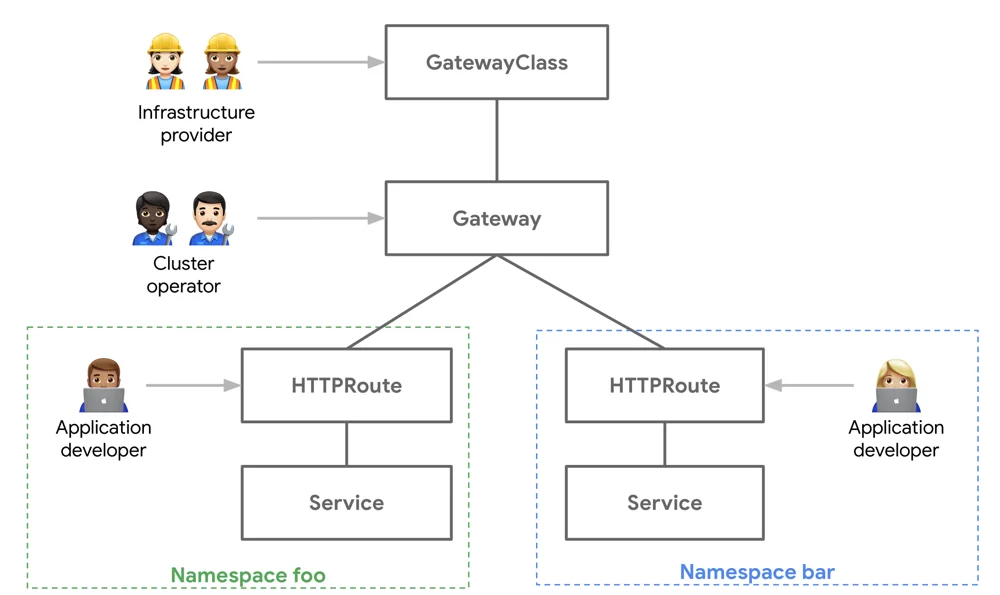
The cleanest organisations separate concerns: a platform team owns the gateway and the approved routes, and application teams choose from those routes without negotiating contracts themselves. Kubernetes networking made the same separation explicit, with infrastructure providers, cluster operators and application developers each owning their own resources5.
Buy models through the route your compliance needs, not the one that is easiest to sign. A gateway lets you hold several routes without your applications noticing.
CTO take
This is a welcome option for Google Cloud shops that want the full Claude Platform without a separate procurement, and the same-day feature access matters for teams building agents. The decision that deserves the most care is the processor and region question: check your data processing agreements, sub-processor lists and residency requirements before moving regulated workloads, especially outside the US (by region). Whatever you choose, keep a gateway in front so the route stays a configuration choice; see LLM model routing, AI provider resilience and build versus buy for AI capabilities.
How I can help
I help teams design model access so that procurement, compliance and engineering decisions do not get tangled. See AI architecture, or analyse your challenge and bring the result to a call.
- 1Claude Platform is now available on Google CloudAnthropic · Oct 2026
- 2Claude's full API now works through Google Cloud billing and account permissionsThe Decoder (Mixed) · Oct 2026
- 3
- 4Anthropic brings Claude directly to Google Cloud with same-day feature accessAlphaSignal · Oct 2026
- 5Evolving Kubernetes networking with the Gateway APIKubernetes blog · 22 Apr 2021