- Every internet-reachable research service found and assigned an owner
- Research tools published only through one authenticated gateway
- Labs able to deploy their own tools within platform guard rails
- Patient data kept in a separate zone from experimental tools
- Security monitoring covering research services for the first time
Anonymised composite. Client names, identifying details and confidential figures are withheld; public facts are cited in the references.
The situation
A Japanese university hospital had a strong central IT function for clinical systems and a very different world in its research labs. Radiology, pathology and informatics groups ran their own AI tools: imaging annotation servers for labelling studies, notebook servers for model development, demo applications for collaborators. Some sat on lab machines, some on cloud accounts paid from research grants, and some were reachable from the internet so partners at other institutions could log in.
The hospital followed the Ministry of Health, Labour and Welfare's guidelines on the safety management of medical information systems, whose version 6.0 was restructured to respond to cyberattacks and wider cloud use, with separate volumes for governance, management and system operations3. Those controls were well applied to clinical systems. Research services were largely outside them.
Why now. In November 2026, Amazon reported that a suspected China-nexus operator used autonomous AI agents to map the API of MONAI Label, an open-source medical imaging annotation tool, find a path traversal flaw and exploit it on university servers in East Asia1. The Register reported the agents went on to gain root2. The hospital's research groups used tools of exactly this kind. The board asked how many such servers were exposed. Nobody could answer.
What had to be true
- Every research service known, with an owner, purpose and the data it can reach.
- Nothing research-related directly reachable from the internet; one authenticated front door instead.
- External collaborators still able to work, with their own identities, not shared passwords.
- Patient data separated from experimental tools, with only de-identified data in research zones by default.
- Research not stopped: labs keep the freedom to deploy, inside guard rails.
Architecture
The data flow, end to end
- DiscoverExternal scans and cloud account reviews find research services
- RegisterEach one gets an owner, a purpose and a data classification
- MoveServices move onto the research platform or are retired
- PublishAccess only through the gateway, with authentication per route
- FeedData reaches tools from the de-identified zone by default
- WatchGateway and platform logs go to the hospital's monitoring
The hard part: central control without central bottlenecks
The easy answer, making central IT deploy every research tool, would have stopped research and pushed labs back to their own servers. The design had to separate who controls the front door from who controls each service. Kubernetes Gateway API is built around exactly that split: infrastructure providers define gateway classes, cluster operators run gateways, and application developers attach their own routes5.
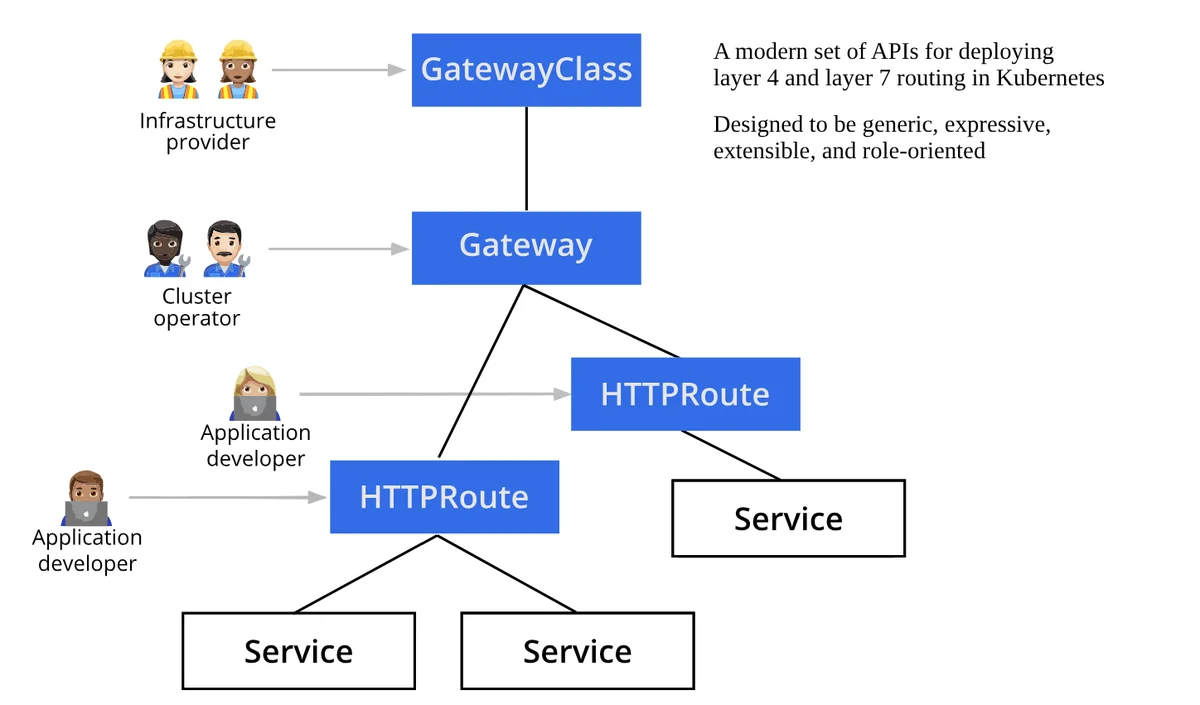
In practice, the hospital's platform team ran the gateway and its authentication; each lab had a namespace and could publish routes to its own tools, which the gateway only accepted with an access policy attached. A new annotation server took the same steps for a lab as before, but could no longer appear on the internet without login.
The fastest win came before any platform work: an external scan of the hospital's address ranges and research cloud accounts. It turned an unknown into a list with owners.
Data was the second half. The ministry also publishes cyber security measures for medical institutions alongside the guidelines4, and the hospital extended the same thinking to research. Research tools received de-identified exports by default; identifiable data stayed in a separate zone that required approval and was never reachable from tools exposed to external collaborators. The pattern follows the health evidence platform and federated health analytics, and the gateway approach builds on moving to Gateway API.
How it ran
- External scans
- Service register and reviews
- Monitoring
- Gateway and identity
- Lab namespaces and approved images
- GPU scheduling
- Confirm owners and purpose
- Move or retire services
- Publish routes with access policies
- External and cloud scans
- Owners for every service
- Close the worst exposures
- Identity-aware gateway
- Collaborator identities
- Route policies
- Lab namespaces
- Approved images
- Data zones
- Continuous scanning
- Monitoring
- Periodic reviews
Key decisions and trade-offs
| Decision | Alternative | Why |
|---|---|---|
| One authenticated gateway for all research tools | Secure each tool individually | Tools vary too much; the front door is the control point |
| Labs own their routes | Central IT deploys everything | Keeps research moving; avoids new shadow servers |
| Federated identities for collaborators | Shared accounts and passwords | Access tied to a person and revocable |
| De-identified data by default | Identifiable data where convenient | Limits harm if a research tool is compromised |
| Retire what has no owner | Leave running until someone complains | Unowned services are never patched |
What I'd do again, and differently
Again: start with an external scan and a service register; it changed the conversation from fear to a list. Differently: bring lab leads in as co-designers of the platform from the first week. Researchers adopted it fastest where they had shaped the deployment templates. See AI-assisted intrusions and the tech news for 22 November.
If you run healthcare or research technology in Japan or across Asia, see my regional work, or analyse your challenge and bring the result to a call.
- 1Amazon: China-Linked Hackers' AI Agents Exploited Medical Software Zero-DaySecurityWeek · Nov 2026
- 2
- 3Guidelines on Safety Management of Healthcare Information Systems Ver. 6.0: outline and major points amendedMinistry of Health, Labour and Welfare (Japan)
- 4Cyber security measuresMinistry of Health, Labour and Welfare (Japan)
- 5Introducing ingress2gateway: Simplifying Upgrades to Gateway APIKubernetes blog (Lior Lieberman, Kobi Levi) · 25 Oct 2023