Looking back at June 2026, the pattern I keep coming back to is maturity. Not new capabilities so much as the plumbing that lets organisations actually run what they already have: identity for agents, cheaper telemetry pipelines, clearer rules for updating AI models in regulated products.
This briefing pulls the month together from primary sources, mostly the projects' own announcements, with my view on what each change means for teams building AI and data platforms.
The month in one paragraph
The Model Context Protocol declared its Enterprise-Managed Authorization extension stable, moving agent tool access under the corporate identity provider1. At the end of the month, beta SDKs arrived for the stateless 2026-07-28 spec2. OpenTelemetry published OTel-Arrow Phase 2 benchmarks, deprecated OpenCensus compatibility and made a pointed case against wrapping its API345. Kubernetes spotlighted the group behind Dynamic Resource Allocation and wrote up its policy on AI-assisted contributions67. And in healthcare, the FDA codified a Class II pathway for machine-learning imaging software with a predetermined change control plan8.
| Item | What changed | Why it matters |
|---|---|---|
| MCP Enterprise-Managed Authorization | Extension declared stable; IdP decides MCP server access | Agent access becomes a central, auditable policy |
| MCP SDK betas | Python, TypeScript, Go and C# betas for the 2026-07-28 RC | Time to test stateless servers before GA |
| OTel-Arrow Phase 2 | Arrow-native Dataflow Engine benchmarks published | A path to much cheaper high-volume telemetry |
| OpenCensus compatibility | Spec requirements deprecated; removal no earlier than June 2027 | Plan the last shim migrations now |
| 21 CFR 892.2055 | FDA final order for ML imaging software with a PCCP | Model updates become a regulated design artefact |
MCP gets an enterprise identity story
Anyone who has rolled out agent tooling inside a company knows the friction: every user authorising every server one by one, no central policy and no single audit trail. The MCP project said as much, describing per-user authorisation as one of the biggest pain points in enterprise environments1.
Enterprise-Managed Authorization makes the organisation's identity provider the decision-maker. During single sign-on the client obtains an identity assertion grant from the IdP and exchanges it for an access token at the MCP server's authorisation server, so the user never sees a per-server consent screen1. Access follows groups and roles the IdP already knows. The announcement named Okta as the first supported identity provider, with client support from Anthropic and Visual Studio Code and a list of servers already on board1.
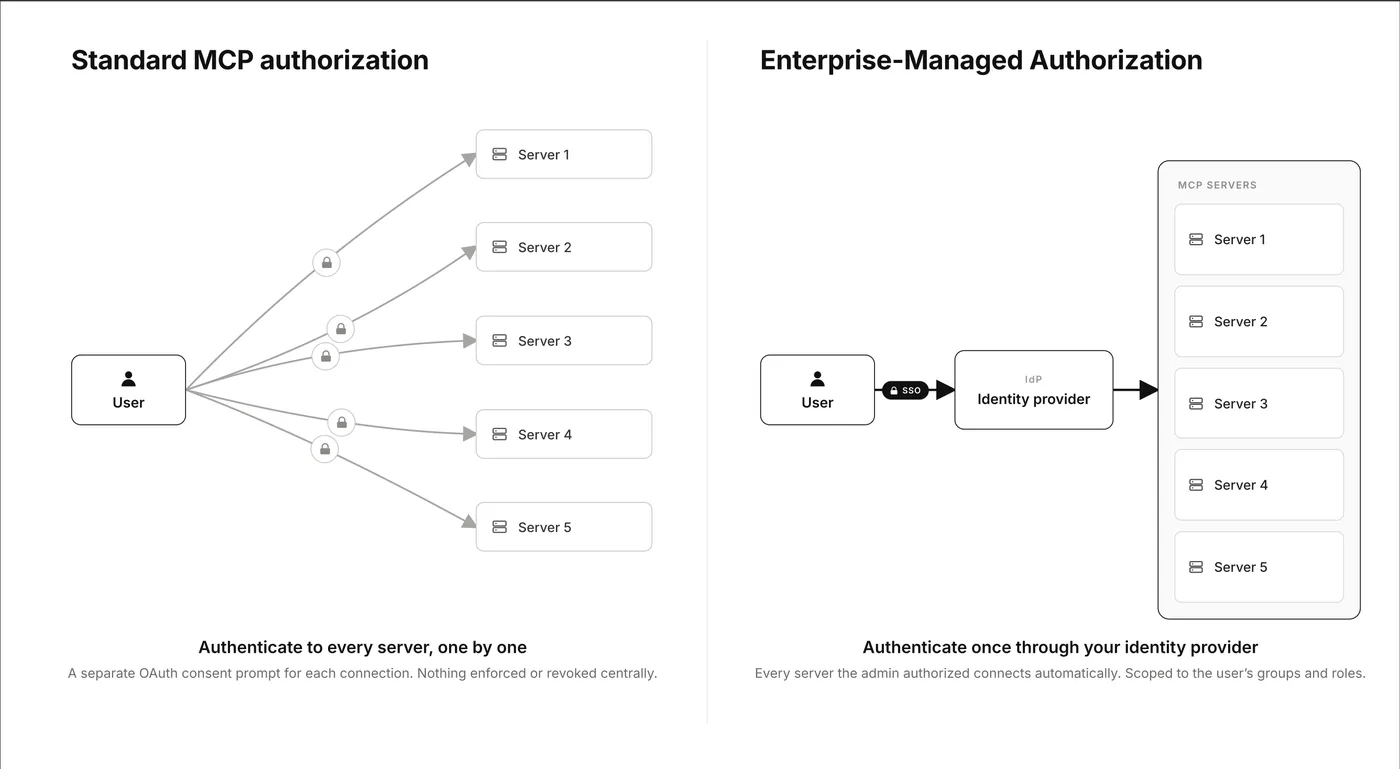
My view: this is the change that makes agent access reviewable by a security team. It does not remove the need for least-privilege scopes per tool or for logging tool calls, which I cover in my MCP security checklist. But it puts the "who may use which server" decision where every other access decision already lives.
The stateless MCP spec arrives in beta
On 29 June the project shipped beta SDKs for the 2026-07-28 release candidate across its four Tier 1 languages2. The headline change is a stateless core: no initialize handshake, no protocol-level session, so any server instance can handle any request behind a plain round-robin load balancer2.
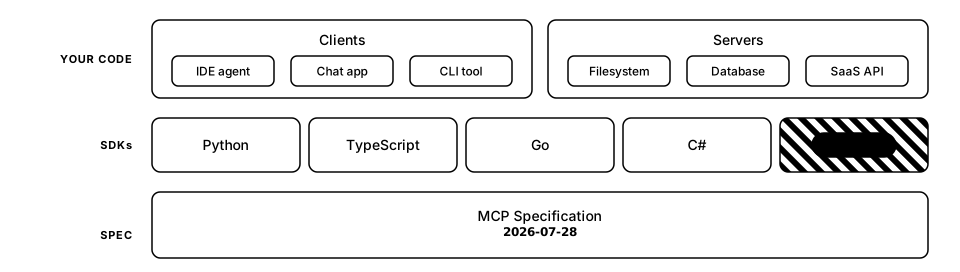
Two details from the post matter for anyone running servers in production. First, nothing breaks on the release date; it is when the normative text publishes, not a switch-off2. Second, method and tool names now travel in HTTP headers, so gateways and rate limiters can route and meter without parsing request bodies2. That is a direct win for the gateway pattern I recommend for enterprise agent platforms.
Practical advice from the post worth repeating: if you publish a library that depends on the Python mcp package, add an upper bound now so the v2 release doesn't surprise your users.
Telemetry pipelines go columnar
OTel-Arrow Phase 2 asked what happens if Apache Arrow is used not just on the wire but as the in-memory representation inside the pipeline3. The team built a Rust Dataflow Engine around OTAP, the OpenTelemetry Arrow Protocol, and compared an Arrow-native path with an OTLP-compatible one on the same runtime.
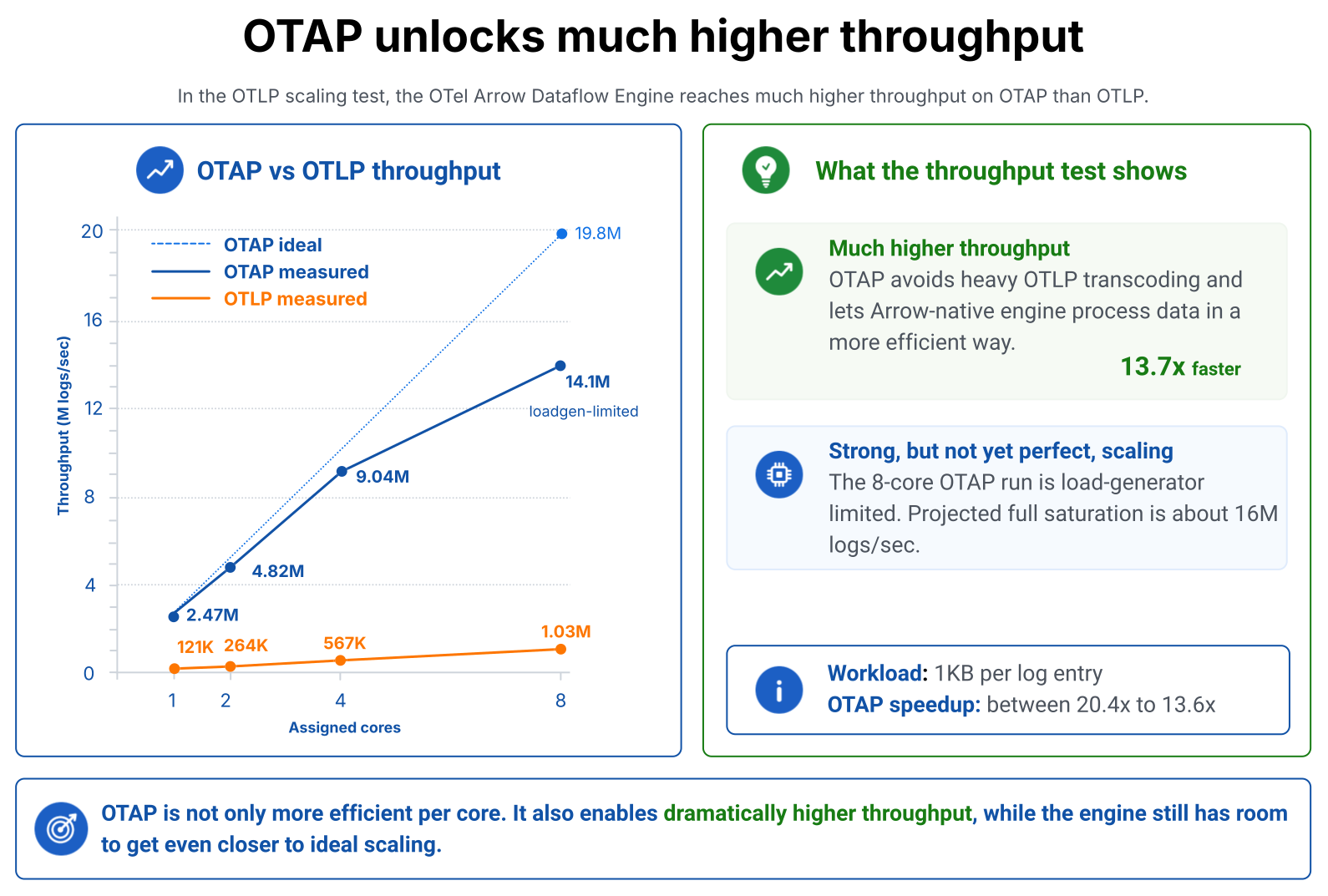
The project reports the OTAP path at roughly 10 to 20 times the throughput of the OTLP path, with 2.47 million logs per second on one core against 121 thousand3. The authors are careful to say these are measurements of specific benchmark paths, not universal claims about every Collector deployment, and I'd read them the same way. Still, for anyone whose observability bill grows faster than their traffic, the direction is clear: conversion boundaries are where the cost hides.
Two smaller OpenTelemetry items round out the month. OpenCensus compatibility requirements were deprecated in the specification, with removal no earlier than June 20274. And a post from a Microsoft maintainer argued against building thin wrappers over the OTel API, showing how they quietly throw away allocation-free designs5. I've seen exactly that wrapper in more than one codebase.
Kubernetes: hardware and AI policy
The Kubernetes blog spotlighted the Device Management Working Group, whose main project, Dynamic Resource Allocation, had recently graduated to GA6. DRA is how Kubernetes allocates GPUs, network interfaces and other hardware beyond CPU and memory. If you're planning GPU clusters for AI workloads, it is now the model to design around.
The project also published how it handles AI-assisted contributions: disclose AI use, keep a human fully accountable, don't list AI as a co-author, and expect to answer review comments yourself7. It is a sensible template for any engineering organisation writing its own policy.
Healthcare: change control for imaging AI becomes regulation
In June the FDA published a final order classifying radiological machine-learning quantitative imaging software with a predetermined change control plan as Class II, codified at 21 CFR 892.205589. The special controls include labelling that the device has a PCCP, a description of implemented modifications and a version history8.
For architects, the significance is that planned model updates become part of the regulated design. Version history, evaluation evidence and traceability back to training data stop being good practice and start being requirements. That only works if the data underneath is governed and standardised, which is why I keep recommending a FHIR to OMOP style analytical layer for clinical AI.
What I'd do with this
- Put agent access under your IdP. If your identity provider supports Enterprise-Managed Authorization, pilot it. If not, at least centralise MCP access through a gateway you control.
- Test the stateless SDKs before GA. Pin exact beta versions in a staging environment and check your load balancer and gateway rules against the new headers.
- Audit your telemetry pipeline for conversion costs. Count how many times a record changes format between source and storage. Each hop is CPU you pay for.
- Remove OTel wrappers and OpenCensus shims from your backlog before they become urgent.
- For regulated AI, design versioning in now. Model registry, evaluation history and data lineage should exist before the first planned update, not after.
How I can help
I help teams design agent platforms, observability pipelines and regulated AI systems that hold up in production. See my AI architecture and healthcare data architecture work, or analyse your challenge and bring the result to a call. Investors assessing AI infrastructure companies can find the same lens in my technical due diligence.
- 1Enterprise-Managed Authorization: Zero-touch OAuth for MCPModel Context Protocol Blog · 18 Jun 2026
- 2Beta SDKs for the 2026-07-28 MCP Spec Release Candidate Are HereModel Context Protocol Blog · 29 Jun 2026
- 3OTel-Arrow Phase 2: From Efficient Transport to Efficient Telemetry PipelinesOpenTelemetry Blog · 12 Jun 2026
- 4Deprecating OpenCensus compatibility requirementsOpenTelemetry Blog · 23 Jun 2026
- 5Don't Wrap OpenTelemetry: You're Probably Hurting More Than HelpingOpenTelemetry Blog · 24 Jun 2026
- 6Spotlight on WG Device ManagementKubernetes Blog · 24 Jun 2026
- 7Open source maintainership in the age of AIKubernetes Blog · 26 Jun 2026
- 8
- 9