- One login and one admin console across both products before any data moved
- Customers migrated in waves, each with a parallel payroll run before cutover
- A single observability view across both clouds during the transition
- Cross-border data flows documented and assessed under both countries' rules
- One engineering organisation with clear ownership of each domain
Anonymised composite. Client names, identifying details and confidential figures are withheld; public facts are cited in the references.
The situation
A Singapore-based HR and payroll software company serving employers across Southeast Asia acquired a smaller Malaysian competitor. The buyer wanted the target's customer base and its depth in Malaysian statutory payroll. The investment case assumed one product within a year and savings from running one platform.
The technology did not line up. The buyer ran a multi-tenant platform on one cloud with its own identity system; the target ran single-tenant deployments on another cloud with a different identity provider. Each had its own payroll engine encoding years of country rules. Both held sensitive employee data: salaries, bank details, identity numbers.
Why now. Technology consolidation is accelerating, from CrowdStrike's agreed all-stock deal for Zscaler valued at about $43.9 billion1 down to many smaller software acquisitions in the region. Most deal value depends on integration, and integration is where it is most often lost. This engagement started the week after the deal closed.
What had to be true
- No customer feels the merger as an outage, and no payroll run is wrong.
- One product to customers early, even while two platforms run behind it.
- Data moves lawfully between countries, with assessments on file.
- One view of production across both clouds during the transition.
- One engineering organisation, with clear ownership, not two teams defending their systems.
Architecture
The data flow, end to end
- UnifyCustomers of both products sign in through one identity provider
- FacadeThe admin console and API route each tenant to its current back end
- ShadowA migrating tenant's payroll runs on both engines and results are compared line by line
- Cut overAfter a clean parallel run, the tenant switches by feature flag
- HoldThe old deployment stays read-only for a rollback window
- RetireData is deleted from the old platform under the retention policy
The hard part: two payroll engines that both claimed to be right
Payroll rules look deterministic until two engines disagree. Rounding, the order in which statutory deductions apply, mid-month joiners and arrears all produced differences. The team ran each migrating customer's payroll on both engines for at least one full period and compared every payslip line. Differences became tickets with an owner from the team that knew each engine best; the acquired team's Malaysian rules knowledge decided many of them, which did more for integration of the two teams than any reorganisation.
Seeing both estates at once was the second problem. The two platforms ran in different clouds and accounts. The team placed OpenTelemetry gateway collectors in each environment and sent telemetry from both into one backend, the same pattern a large travel platform describes for receiving telemetry from multiple accounts through gateway collectors4.
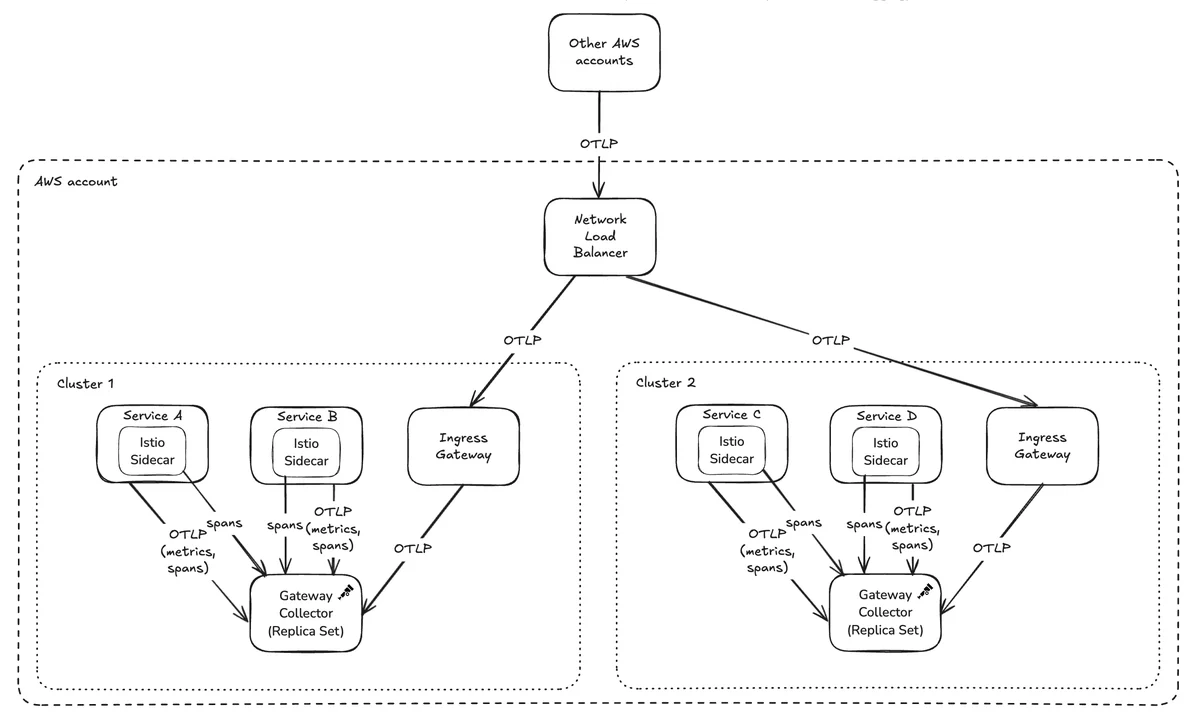
Integrate identity before data. One login across both products gave customers a single company to deal with months before any data moved, and took the pressure off the riskiest migrations.
Data protection shaped the migration order. Singapore's PDPA restricts transfers of personal data outside Singapore unless the receiving organisation provides comparable protection2, and Malaysia's amended PDPA replaced its whitelist with a test of whether the destination provides substantially similar or equivalent protection3. Each migration wave had a documented assessment and intra-group contract terms before data moved, and Malaysian customers whose contracts required in-country hosting stayed on in-country infrastructure. Patterns from multi-tenant SaaS design and SaaS re-architecture applied directly.
How it ran
- Customer communication plan
- Migration wave scheduling
- Feedback after each wave
- Identity and facade
- Parallel payroll runs
- Tenant migration and retirement
- Transfer assessments
- Intra-group contracts
- Retention and deletion
- Joint on-call and incident process
- Shared observability
- No new divergence
- One identity
- One admin console
- API facade
- Waves by segment
- Parallel payroll runs
- Rollback windows
- Old platform shut down
- Data deleted
- Costs consolidated
Key decisions and trade-offs
| Decision | Alternative | Why |
|---|---|---|
| Identity and console first | Data migration first | One product to customers early, with low risk |
| Migrate in waves with parallel runs | Big-bang cutover | Payroll errors are not recoverable after payday |
| Keep the acquired payroll rules where better | Buyer's engine wins by default | Local expertise was part of the deal value |
| Transfer assessment per wave | One assessment for the whole programme | Data sets and destinations differed by wave |
| Organise by domain, mixed teams | Keep acquired team separate | Avoids two camps defending two systems |
What I'd do again, and differently
Again: set up joint on-call and shared observability in the first weeks; nothing builds trust between two engineering teams faster than fixing incidents together. Differently: be involved before signing. Several integration costs, such as the single-tenant contracts with in-country hosting commitments, were knowable during technical due diligence and would have changed the plan and the price. See team topologies and technical debt without a rewrite.
If you are integrating an acquisition in Singapore or Southeast Asia, my work in the region explains how I approach it, or analyse your challenge and bring the result to a call.
- 1CrowdStrike to acquire Zscaler for $44 billionTechCrunch · 23 Nov 2026
- 2Personal Data Protection Act overviewPersonal Data Protection Commission Singapore
- 3
- 4How Skyscanner scales OpenTelemetry: managing collectors across 24 production clustersOpenTelemetry blog (Developer Experience SIG) · 21 Apr 2026