- Models served from more than one accelerator type behind one gateway
- Images matched to compatible nodes automatically
- Quality and latency checked per accelerator before traffic moves
- Capacity sourced from more than one provider in Brazil
- Customer data kept in-country on every serving path
Anonymised composite. Client names, identifying details and confidential figures are withheld; public facts are cited in the references.
The situation
A Brazilian software company sold AI features to retailers and banks: customer service assistants, document extraction and product search, built on open-weight models it had fine-tuned. It served them from GPUs rented in a São Paulo cloud region, because customers expected their data to stay in Brazil under the LGPD's rules on personal data5. Every part of the serving stack, from container images to the serving engine and capacity contracts, assumed one GPU family and one provider.
Why now. In November 2026 the US issued a rule requiring licences for exports of advanced AI chips to several countries, including Brazil, and tightening remote access to such chips12. At the same time, cloud providers were pushing their own accelerators harder; Amazon was reported to be near a deal for Decart, whose software helps models run on AWS's own chips3. For a company whose margins depended on inference cost, being tied to one chip in one region had become a business risk, not just a technical preference.
What had to be true
- Models servable on more than one accelerator type, with evidence that quality held.
- Applications unaware of the hardware: one interface, routing decided by the platform.
- No accidental mismatches: images only scheduled where drivers and hardware fit.
- Capacity from more than one provider, all inside Brazil.
- Cost visible per model, per accelerator, so choices were made on numbers, not habit.
Architecture
The data flow, end to end
- TrainFine-tuned weights are stored once in an open format
- BuildServing images are built per accelerator, each declaring its requirements
- EvaluateEach build runs the same evaluation set for quality, latency and cost
- ScheduleImages land only on nodes whose features match
- RouteThe gateway sends traffic by policy, starting small on new pools
- MeasureCost and latency per model and pool feed the next routing decision
The hard part: the same model is not quite the same on different chips
Moving a model between accelerators sounds like a deployment detail. In practice the serving engine, numerical precision, kernels and memory limits differ, and small differences in outputs show up in exactly the places customers notice: extraction fields, tone, refusals. The team treated every accelerator build as a new release of the model, with the same evaluation set and acceptance thresholds as a retrain, before any production traffic moved.
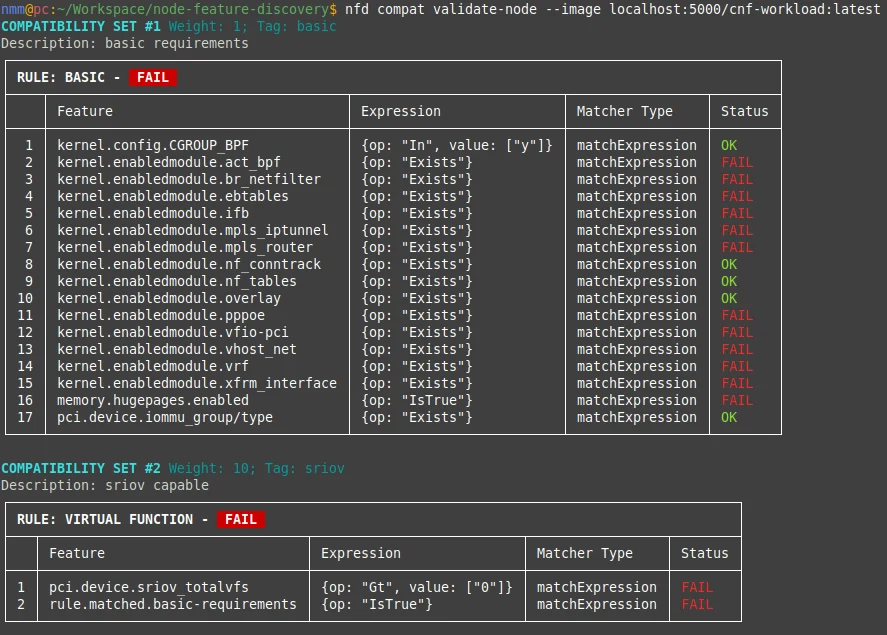
The second trap was scheduling. An image built for one accelerator and its drivers must never land on a node that cannot run it. Node Feature Discovery reports hardware and system features of each node, and its image compatibility work lets an image declare requirements such as drivers and kernel features that can be validated against a node before scheduling4.
Portability is not free. Each additional accelerator adds a build, an evaluation run and an operational pool. The team supported two serving accelerator types plus CPU, and stopped there.
The gateway and routing approach follows LLM model routing and Kubernetes inference gateways; serving engine choices are covered in LLM inference serving, and capacity planning in the multi-region AI capacity case study.
How it ran
- Open weight formats
- Per-accelerator evaluation
- Acceptance thresholds
- Images with declared requirements
- Feature-aware scheduling
- Gateway routing and telemetry
- Second provider in Brazil
- Capacity terms
- Data residency in contracts
- Model gateway
- Apps off direct endpoints
- Cost telemetry
- Second accelerator builds
- Evaluation per build
- Latency and cost data
- Second provider pool
- Feature-aware scheduling
- Small traffic shares
- Routing by cost
- Batch work to cheaper pools
- Quarterly capacity review
Key decisions and trade-offs
| Decision | Alternative | Why |
|---|---|---|
| Gateway in front of every model | Apps call serving endpoints directly | Moving hardware becomes a routing change |
| Treat each accelerator build as a release | Assume identical behaviour | Outputs differ in ways customers notice |
| Images declare hardware requirements | Rely on node labels by convention | Mismatches caught before scheduling |
| Two accelerator types plus CPU | Support everything | Each target adds builds, tests and operations |
| All pools inside Brazil | Cheapest region anywhere | Customer contracts and data protection expectations |
What I'd do again, and differently
Again: put the gateway in first; it made every later step cheaper and gave the cost data that justified the rest. Differently: write evaluation sets for each product before starting, not during the first migration. The slowest part was agreeing what "good enough" meant for each customer-facing task. See evaluation sets that predict production and the tech news for 23 November.
If you run AI products in Brazil or across Latin America, see my regional work, or analyse your challenge and bring the result to a call.
- 1
- 2Addressing Remote Access to Advanced SemiconductorsFederal Register · 19 Nov 2026
- 3Amazon Nears $7.5 Billion Deal for AI Startup DecartPYMNTS · Nov 2026
- 4Image Compatibility In Cloud Native EnvironmentsKubernetes blog (Chaoyi Huang, Marcin Franczyk, Vanessa Sochat) · 25 Jun 2025
- 5Lei nº 13.709, de 14 de agosto de 2018 (Lei Geral de Proteção de Dados Pessoais)Presidência da República (Brazil)