- No GPU capacity without completed customer screening and ownership checks
- GPU jobs admitted only when the tenant's compliance status allows it
- A traceable record of who used which GPUs, when and from where
- Unusual usage patterns surfaced for review rather than discovered later
- Evidence ready for licence applications, audits and supplier questions
Anonymised composite. Client names, identifying details and confidential figures are withheld; public facts are cited in the references.
The situation
A Malaysian data centre operator added a GPU cloud to its colocation business, offering training and inference capacity to start-ups, enterprises and university labs across South-East Asia. Customers signed up online, were given a Kubernetes namespace and GPU quota, and could start work within a day. Onboarding checked payment details and little else.
Malaysia had already tightened its own controls: since July 2025, exporting, transshipping or moving US-origin high-performance AI chips through the country requires a permit under the Strategic Trade Act34. The operator's hardware stayed in its own halls, so that rule mostly affected its suppliers. The bigger question was who was using the hardware remotely.
Why now. In November 2026, the US Commerce Department's Bureau of Industry and Security issued a rule requiring licences for advanced AI chips going to Malaysia, Indonesia, Singapore, Thailand and Brazil, and aimed at stopping restricted parties from reaching controlled chips through data centres in third countries12. For a GPU cloud in Malaysia, that made its customer list part of its supply chain: future hardware purchases would depend on being able to show where compute went.
What had to be true
- Known customers: every tenant screened, including who ultimately owns or controls it.
- Gated access: no GPU capacity until checks are complete, and access paused if they lapse.
- Known users: every person and service using a tenant's GPUs identifiable.
- Traceable usage: who used which GPUs, when and from where, kept as evidence.
- Watchful: unusual patterns surfaced for review.
- Still easy to buy: legitimate customers onboard in days, not months.
Architecture
The platform already used Kueue to queue and admit GPU jobs fairly across tenants. That admission step became the enforcement point. Each tenant's queue was linked to its compliance status: if screening was incomplete, had expired or was under review, the tenant's jobs stayed suspended rather than running. Kueue's model of jobs waiting in a queue until admitted made this a configuration change rather than a new system5.
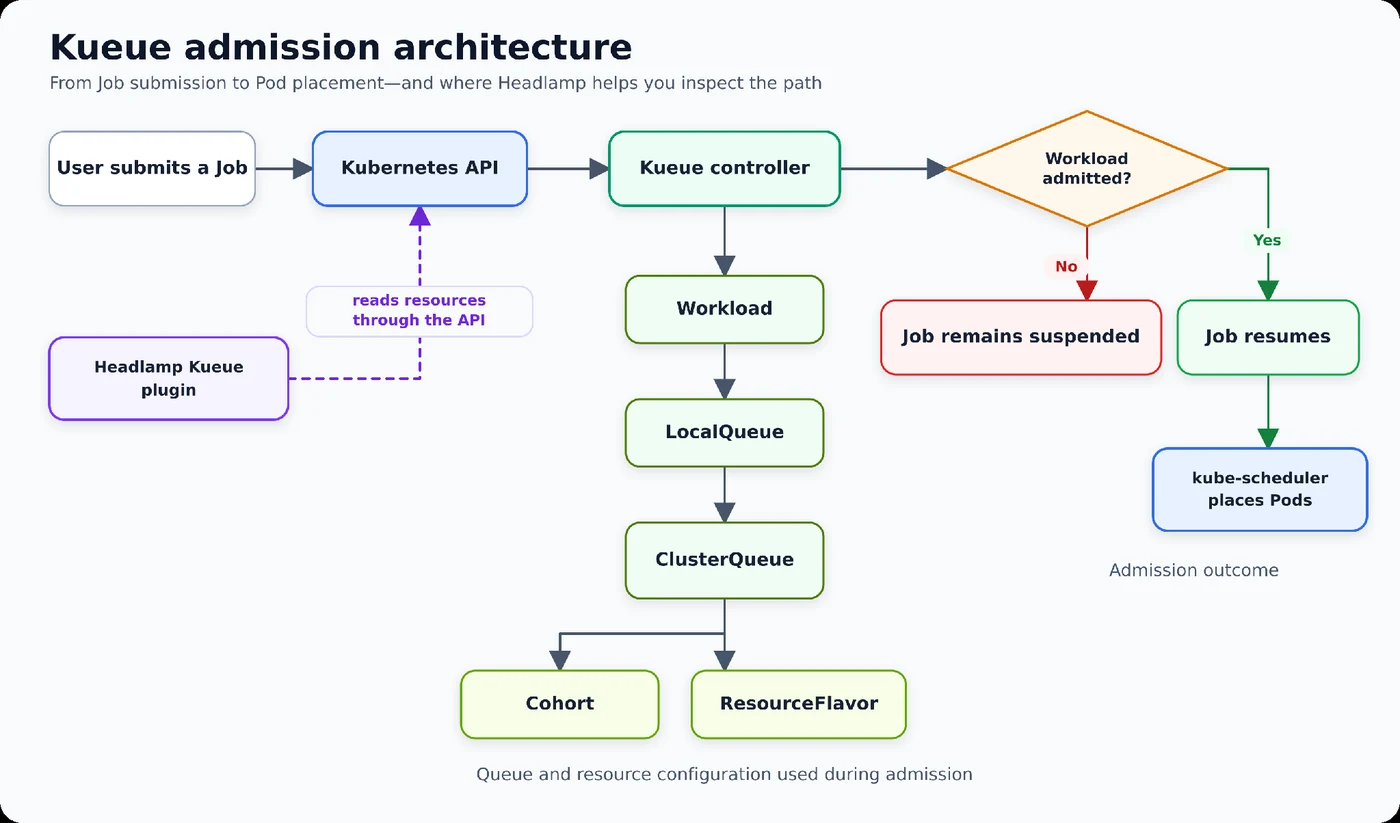
The data flow, end to end
- ApplyA customer signs up, declares intended use and provides ownership details
- ScreenRestricted-party and ownership checks run; edge cases go to a person
- ProvisionA tenant is created with quota linked to its compliance status
- AdmitEach GPU job is admitted only if the tenant's status allows it
- RecordJobs and access are logged with identity, source and hardware used
- ReviewPeriodic rescreening and anomaly alerts keep status current
The hard part: remote access and changing customers
Who is really using the GPUs? A screened customer can resell capacity, share credentials or be acquired. The operator required named user identities with multi-factor sign-in, prohibited credential sharing and resale without approval in its terms, and logged where each session came from. Monitoring looked for patterns worth a human look: many users appearing under one small tenant, access from unexpected locations, or workloads that did not match the declared use.
Rescreening without friction. Ownership and restricted-party lists change. Rather than rescreen everyone at once, the platform rescreened tenants on a schedule and whenever lists were updated or a tenant's details changed, pausing only those with new matches for review. Legitimate customers rarely noticed.
Not a law firm. Export-control questions often need legal judgement. The platform's job was to collect facts and enforce decisions consistently; edge cases went to compliance staff and external counsel, and their decisions were recorded alongside the evidence.
For a GPU cloud, the customer list is now part of the hardware supply chain. Build compliance into the scheduler, not a spreadsheet, so it cannot be bypassed on a busy day.
How it ran
- Tenant status in queues
- Admission gating
- Access logging
- Screening rules
- Edge-case decisions
- Rescreening schedule
- Clear onboarding steps
- Customer communication
- Resale and sharing terms
- Risk appetite
- Supplier and regulator engagement
- Licence applications
- Screen existing tenants
- Ownership checks
- Asset register
- Status-linked queues
- Suspend on lapse
- Named users and MFA
- Access logging
- Anomaly review
- Scheduled rescreening
- Evidence store
- Audit-ready reports
- Licence support
Key decisions and trade-offs
| Decision | Alternative | Why |
|---|---|---|
| Enforce in the scheduler | Manual checks before provisioning | Cannot be skipped under pressure |
| Suspend jobs, do not delete tenants | Terminate access on any doubt | Review without losing customers' work |
| Named users with MFA | Shared tenant credentials | Know who actually uses the GPUs |
| Event-driven rescreening | Annual review only | Catches changes when they happen |
| Humans decide edge cases | Fully automated decisions | Legal judgement stays with people |
| Evidence store from day one | Assemble evidence when asked | Supports licences and audits quickly |
What I'd do again, and differently
Again: put enforcement in the admission step of the scheduler; it made compliance consistent without slowing engineers. Differently: involve the hardware suppliers earlier, since their own export obligations shaped what evidence they needed from the operator. Related: the 17 November tech news, AI capacity contracts, the shared GPU case study and where I work.
If you run or buy GPU capacity in a market facing new export rules, see my AI architecture work, or analyse your challenge and bring the result to a call.
- 1
- 2Commerce Department moves to close AI chip loopholeNextgov/FCW · Nov 2026
- 3Miti requires permit for US-made AI chip exportsThe Star · 15 Jul 2025
- 4Malaysia Introduces New Export Control Directive for Advanced AI ChipsBaker McKenzie · 2025
- 5Why Is My Kubernetes Job Still Pending? Tracing Kueue Admission with HeadlampKubernetes blog · 14 Oct 2026