- Scam signals from payments, devices, customers and partners in one case view
- Higher-risk payments slowed with targeted friction instead of blanket holds
- Intelligence turned into disruption and regulator reports as tracked work
- Every intervention recorded with the signals and rule or model behind it
- Complaints and reimbursement handled from the same evidence
Anonymised composite. Client names, identifying details and confidential figures are withheld; public facts are cited in the references.
The situation
A mid-sized, customer-owned Australian bank had sound fraud controls for the problems of a decade ago: stolen card numbers, compromised passwords, account takeover. Its losses had shifted to a different pattern. Customers were being talked into sending money themselves, through investment, impersonation and romance scams, and the bank's systems saw a properly authenticated customer making a real-time payment. Every control said the payment was legitimate, because technically it was.
The Scams Prevention Framework changes what a bank is expected to do about that. Passed in February 2025, it sets overarching principles for designated sectors: governance, prevent, detect, report, disrupt and respond1. When a bank has actionable scam intelligence, meaning reasonable grounds to suspect a scam connected with its service, it must report it to the ACCC and take reasonable steps to disrupt it, with a safe harbour for disruption while it investigates, for up to 28 days2.
Why now. Banking, telecommunications and digital platforms have been designated as the first sectors, and the framework is moving from principles to detailed sector codes4. Treasury released draft rules and codes, including a common code and a banking code, for consultation in May 20263. The obligations are close enough that the platform work had to start now, not after the final text.
What had to be true
- Scams treated as their own problem, not as a subset of unauthorised fraud.
- One view of a scam across payments, devices, customer reports and intelligence from other organisations.
- Friction that matches risk: most payments untouched, the risky few slowed in ways that actually break the scammer's script.
- Intelligence acted on in hours, with reporting and disruption tracked as work, not emails.
- Evidence for every intervention, strong enough for a complaint, an external dispute or the regulator.
Architecture
The data flow, end to end
- InitiateA customer starts a payment; payment and session events go on the stream
- ScoreRules, model and graph lookups score the payment in the payment path
- InterveneHigher risk gets targeted friction: a specific warning, confirmation or hold
- LearnOutcomes and customer reports flow back as intelligence
- Disrupt and reportActionable intelligence opens a case to block, restrict and report
- EvidenceThe decision, signals and actions are stored for complaints and review
The hard part: proving reasonable steps, case by case
A framework built on reasonable steps is judged after the event. A customer complains weeks later; the question is what the bank knew at the moment of the payment, and what it did. Fraud systems usually keep a score and an outcome. That is not enough. The design stored an immutable decision record for every payment that was scored above the lowest threshold: the signals present, the rule or model version, the friction shown and the customer's response.
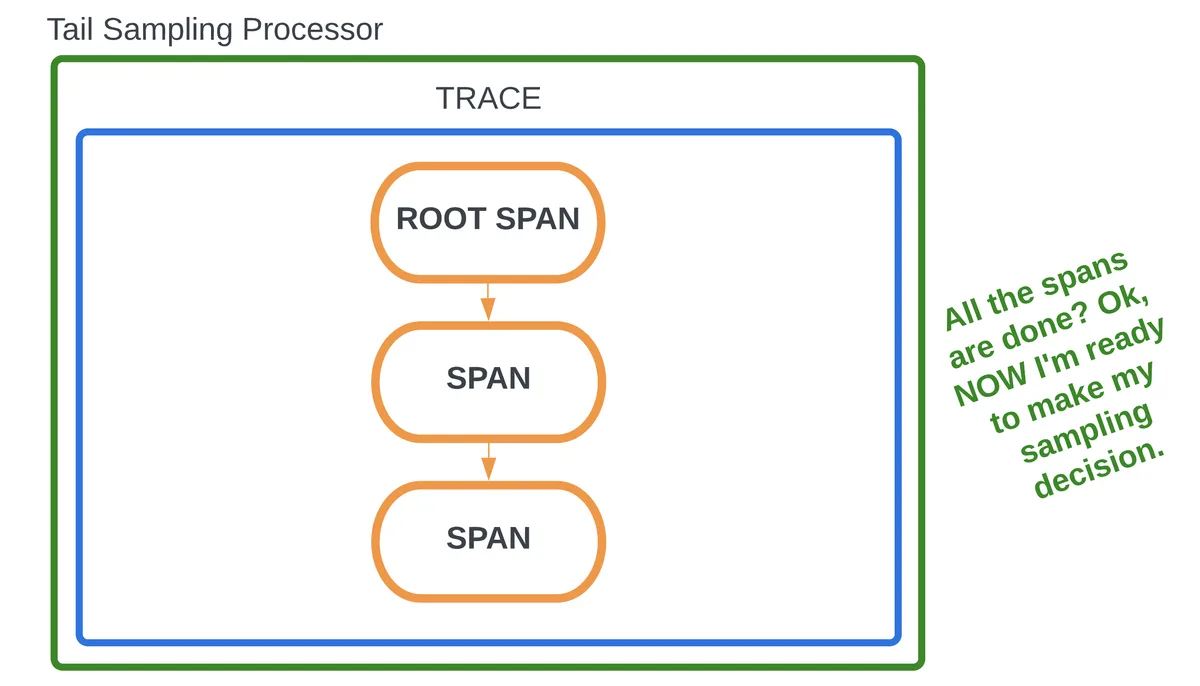
Traces were the second layer. Keeping a full trace for every payment would be expensive and mostly useless. Tail sampling in the OpenTelemetry Collector makes the keep-or-drop decision after all spans in a trace are complete5, so the team kept every trace for a flagged, held or interrupted payment and a small sample of the rest.
Traces cannot be the only record. A scam reported a week later was never flagged at the time, so its trace may be gone. The decision record is the evidence; traces are the detail when you still have them.
The entity graph followed the approach in the fraud ring knowledge graph, using entity resolution to connect payees, mule accounts, phone numbers and websites across reports. The LLM triage step turned free-text customer reports into structured intelligence, with a person confirming anything that would trigger disruption; it was evaluated on real, de-identified reports first, as in evaluation sets that predict production.
How it ran
- Map principles to controls
- Define actionable intelligence
- Board and regulator reporting
- Payment event stream
- Scoring, graph and friction
- Evidence store and traces
- Scam case handling
- Customer friction scripts
- Complaints and reimbursement
- Scam loss patterns
- Gaps against principles
- Draft code review
- Event stream
- Entity graph
- Case store
- Risk scoring
- Targeted friction
- Disruption and reports
- Evidence store
- Control testing
- Track final codes
Key decisions and trade-offs
| Decision | Alternative | Why |
|---|---|---|
| Separate scam models from fraud models | Extend the existing fraud model | The customer is genuine; the signals and the right response are different |
| Targeted friction, such as a scam-specific question | Generic warnings on every payment | Customers learn to click past generic warnings |
| Intelligence as cases with owners and clocks | Alerts in a shared inbox | Reporting and disruption must be timely and provable |
| Person confirms LLM-extracted intelligence | Automatic action on model output | Wrongly blocking a payee harms a real customer |
| Decision records for every scored payment | Rely on logs and traces | Logs rotate; complaints arrive weeks later |
| Build to the principles, track the codes | Wait for final codes | The principles are stable; the detail can be tuned |
What I'd do again, and differently
Again: start with the evidence record and the case model, because they shape everything else, and treat the regulator's definition of actionable intelligence as an engineering requirement with a threshold and an owner. Differently: bring operations and the contact centre in on friction design from the first week. The best interventions came from the people who talk to scam victims, not from the risk model. Related patterns are in idempotent payment pipelines and deepfake-resistant onboarding.
If you run a regulated Australian business, my work with Australian companies explains how I approach it, or analyse your challenge and bring the result to a call.
- 1Scams Prevention Framework: Protecting Australians from scamsThe Treasury (Australia) · Jan 2025
- 2Explainer: Australia's new Scam Prevention FrameworkBird & Bird · 2025
- 3Australia: Scams Prevention, draft code and rules releasedBaker McKenzie · Jun 2026
- 4'Click Here': Australia's Scam Prevention Framework takes shapeGilbert + Tobin · 2026
- 5Tail sampling with OpenTelemetry: why it's useful, how to do it, and what to considerOpenTelemetry blog (Reese Lee) · 26 Sep 2022