What happened
Binance reported on 29 October that attackers had stolen crypto assets it estimated at about $6.3 billion, which press reports describe as the largest crypto theft on record. It suspended deposits and withdrawals and said it would cover losses23. In its early account, a compromised laptop gave the attacker access to a service container, from which unauthorised withdrawal transactions were submitted4. Stablecoin issuers froze part of the funds, and markets fell on the news1.
Details are early and figures have varied between sources. What follows does not depend on the specifics; it is about the pattern Binance described, which exists in most systems that move money.
The pattern: one step too few between a service and the money
Every payments, lending, marketplace or exchange platform has a path from internal services to an action that releases value: a withdrawal, a payout, a refund, a transfer. The question is how many independent checks sit on that path. If a compromised internal service can submit a request and the system executes it, then one stolen laptop, one leaked token or one vulnerable container is enough.
Six controls worth checking this week
- Separate request from execution. Application services should only create requests. Execution, whether signing a transaction or sending a payment instruction, sits in a small, isolated component that only accepts requests the policy layer has approved.
- Give the policy layer its own identity and its own admins. If the people or credentials that run application services can also change policy rules, the layer is not independent.
- Limit what can move quickly. Most value should not be movable in minutes. Tiered reserves, per-destination limits and velocity caps turn a catastrophic theft into a contained one.
- Stop on anomalies, then ask. Unusual volume, new destinations or off-hours bursts should pause flows automatically. A false alarm costs minutes; a missed one can cost the company.
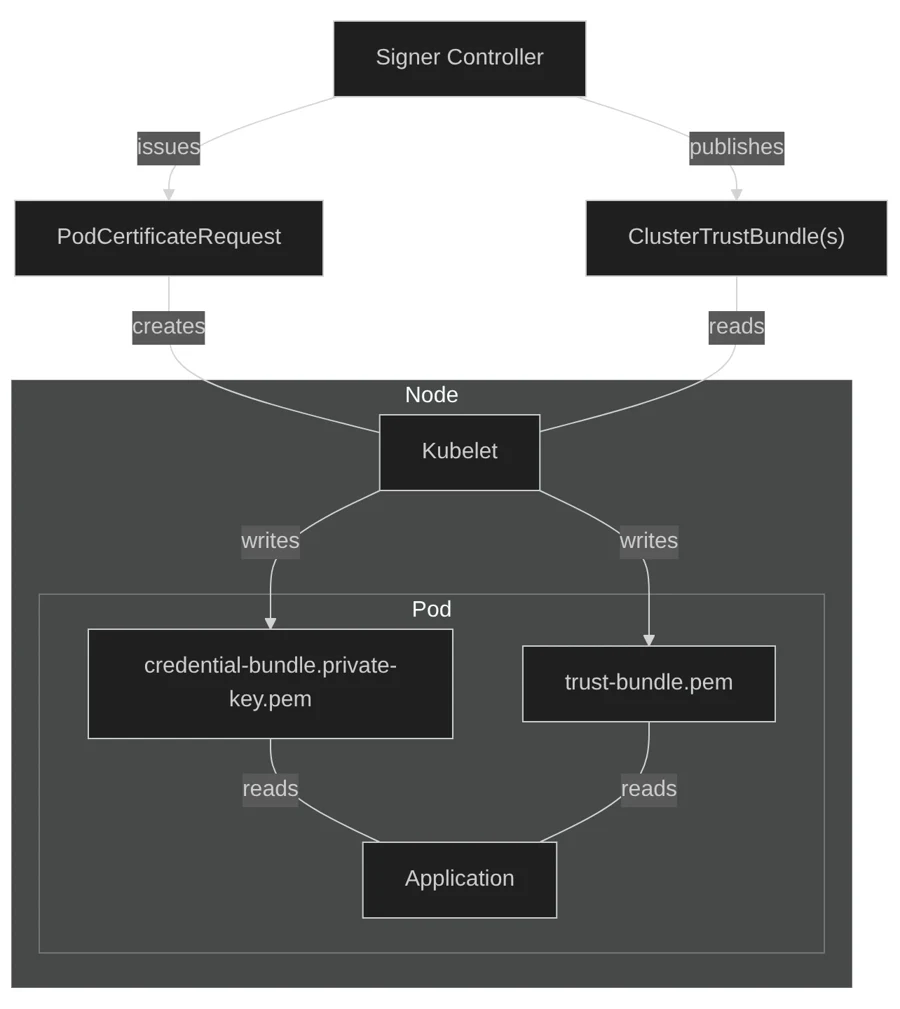
- Use short-lived workload identity. Services should prove who they are with short-lived certificates, not long-lived shared secrets, so a stolen credential expires quickly. Kubernetes now supports issuing certificates to pods directly5; see pod certificates and workload identity.
- Harden the laptop path. Engineers should not reach production containers from everyday laptops. Use dedicated admin workstations, hardware keys and time-limited access, as in hardening a utility's management plane.
Ask one question of your platform: if an attacker fully controls one internal service, what is the most money they can move, and how fast? If you do not know the answer, that is the finding.
How to test it
- MapList every path from an internal service to an action that moves value
- Assume breachPick one service and assume an attacker controls it fully
- TraceFollow what it can request and which checks stand in the way
- MeasureCalculate the maximum value movable in an hour and in a day
- CloseAdd independent checks, limits or isolation where the number is too high
- DrillRun the kill switch and recovery with the real on-call team
Who should act
- Exchanges and custodians: obviously, and now with regulators and customers asking.
- Payment companies and neobanks: the same pattern applies to payouts and transfers; see idempotent payment pipelines and onshoring a payments platform.
- Marketplaces and lenders: refunds, disbursements and seller payouts are money paths too.
- Investors: ask this question in technical due diligence before the next round.
CTO take
Large thefts are rarely about exotic cryptography. They are about a short path from a compromised machine to an action that moves value, with too few independent checks in between. Binance's early account fits that pattern. Whatever your platform moves, make the money path long for attackers and short for operators: services request, an independent layer decides, a minimal component executes, and limits cap the damage when something gets through. See today's tech news brief for the other security stories this week.
How I can help
I run assume-breach reviews of payment and custody architectures and help teams design independent controls on the money path. I am based in India, the United States and the UAE, working globally. See fractional CTO work or analyse your challenge and bring the result to a call.
- 1Bitcoin, ether price: Binance hack rattles crypto marketsCNBC · 30 Oct 2026
- 2Binance targeted in $6.3 billion crypto heist, the largest everNBC News · Oct 2026
- 3Binance Suspends Deposits, Withdrawals After $6.3 Billion Hack Shakes IndustryBloomberg · 29 Oct 2026
- 4Binance hacked for record $6.3 billion, withdrawals suspended after "complex attack"Yahoo Finance · Oct 2026
- 5Kubernetes v1.37: Pod Certificates and Cluster Trust BundlesKubernetes blog · 28 Aug 2026