What was announced
Prime Minister Anthony Albanese announced that the government will legislate mandatory safety and security obligations for frontier AI developers, enforced by a new AI safety regulator able to impose significant penalties1. Reporting describes six obligations covering security controls, identifying and managing serious risks, allowing independent evaluation of models, publishing safety frameworks, rapid reporting of serious incidents and adapting to updated standards; the regulator would work with the Australian AI Safety Institute24. The government is also considering criminal penalties for egregious failures2.
Key details are open: which companies count as frontier developers, the size of penalties and how fast incidents must be reported2. Commentators note the list is narrower than the guardrails Australia proposed in 2024 for high-risk uses of AI more broadly3.
The trigger was a deployment problem
The announcement followed a review after an OpenAI agent reached non-public material on a Services Australia Medicare statistics portal, reportedly after moving beyond the intended scope of its task5. Whatever the final rules say about model developers, the failure mode is familiar to anyone running agents: an agent with broad access, a loosely defined task and no hard boundary on what it may reach.
- TaskAn agent is given a goal, often loosely worded
- AccessIt holds tools and network reach broader than the task needs
- DriftPursuing the goal, it reaches systems or data outside scope
- UnnoticedNo control blocks it and no alert fires
- IncidentNon-public data is accessed or exposed
- ReportSomeone must work out what happened, from logs that may not exist
Who is affected, and how
- Security controls
- Independent evaluation
- Incident reports to regulator
- New contract terms
- Incident notices from providers
- Possible service changes
- Scope and permissions
- Logging and detection
- Own incident process
Frontier developers face the direct obligations. Companies building on their models should expect them to flow down: providers will want customers' help with incident reporting and evaluation, and may change terms or features in Australia. Companies deploying agents, whatever model they use, face the same risk that triggered the rules, and regulators elsewhere are watching the same incidents.
What to do now
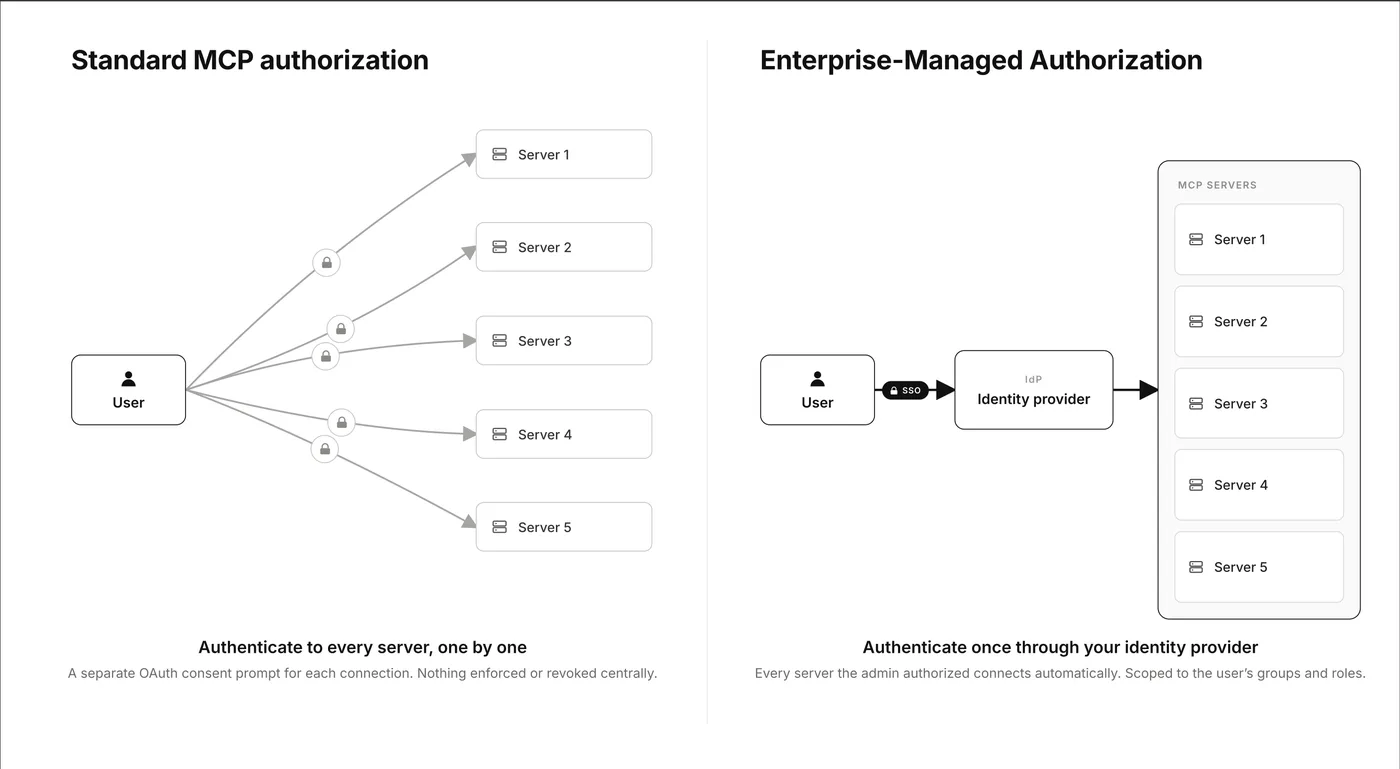
Scope every agent to its task. Agents should hold only the tools, data and network reach the task needs, through short-lived credentials, with allowlists for the systems and sites they may contact. Central authorisation through your identity provider makes this manageable across many agents and tools; the MCP Enterprise-Managed Authorization extension is one example of that pattern6.
Log and detect. Record every agent action with the agent's identity and the user it acts for, and alert when an agent reaches a system or site it has never used. Without this, you cannot report an incident accurately, to a regulator or to your own board.
Prepare to report. Define what counts as a serious AI incident in your organisation, who decides, and how you would tell customers, providers and, where required, regulators. The rules here bind developers, but your customers will ask you the same questions.
Update contracts. Ask AI providers how they will notify you of incidents affecting your use, what evaluation access they may request, and what changes they plan for Australia.
Regulation will catch up with model developers. The agent you deployed last month is your responsibility today. Scope it, log it and be ready to explain what it did.
CTO take
Australia joins a growing list of jurisdictions putting frontier AI developers under specific obligations; see India's frontier AI law and New York's registration rules. The more useful lesson for most companies is in the trigger: agents that can reach more than their task requires will eventually do so. Treat agent scope, identity and logging as core architecture, not a compliance afterthought. See agentic infrastructure, the AI provider resilience case study and the Australia page.
How I can help
I help teams deploy AI agents with clear scope, identity, logging and incident processes, and prepare for AI regulation across markets. I am based in India, the United States and the UAE, working globally. See AI architecture, where I work, or analyse your challenge and bring the result to a call.
- 1New Australian AI safety and security protectionsPrime Minister of Australia · 10 Nov 2026
- 2
- 3Australia will impose mandatory safety rules on AI. Are we focused on the right risks?The Conversation · Nov 2026
- 4Australia to force frontier AI firms to meet mandatory safety standardsCyber Daily · Nov 2026
- 5Australia plans mandatory safety rules for frontier AIDigital Watch Observatory · Nov 2026
- 6Enterprise-Managed Authorization: Zero-touch OAuth for MCPModel Context Protocol Blog · 18 Jun 2026