- One product codebase serving global and China editions
- Chinese customers' prompts, answers and profiles kept in China
- Only non-personal catalogue data flowing into China, nothing personal flowing out
- Chinese-language quality measured on its own evaluation set before launch
- Filing and transfer documentation prepared from the architecture, not after it
Anonymised composite. Client names, identifying details and confidential figures are withheld; public facts are cited in the references.
The situation
A European skincare and personal care brand sold online and through partners in Europe, the US and China. Its AI shopping assistant answered questions about ingredients and products, built routines from a short questionnaire and handed off to customer service when needed. It ran on a global model provider, with logs and customer profiles in the brand's European cloud. China had its own app, mini-programme and marketplace stores, but no assistant.
Why now. On 31 October 2026, Apple and Alibaba said Alibaba's Qwen will power the China edition of Apple Intelligence, a clear signal that even global platforms ship a different model in China to meet local rules1. China's Interim Measures for generative AI services require qualifying public-facing services to go through filing with the Cyberspace Administration of China2, which publishes lists of filed services in batches3. And the Personal Information Protection Law governs any transfer of Chinese customers' data abroad, with certification measures in effect from 1 January 2026 alongside the standard contract and security assessment routes4. The brand's leadership wanted a Chinese edition for the next sales season, built the right way.
What had to be true
- A locally permitted model for Chinese users, with the application registered where required.
- Personal data stays in China: prompts, answers, profiles and logs.
- One product, not two: shared code and features, with market-specific configuration.
- Chinese-language quality proven on a local evaluation set before launch.
- Documentation that follows the design: filing, impact assessment and transfer analysis drawn from the architecture.
Architecture
The data flow, end to end
- AskA customer in the China app asks about a product or a routine
- RouteThe router sees the market and sends the task to the China region
- GroundThe answer is grounded in the locally synced catalogue and the customer's in-country profile
- GenerateThe locally filed model drafts the answer under localised safety rules
- RecordPrompts, answers and telemetry are stored in China only
- Hand offIf needed, the conversation passes to the China customer service team
The hard part: one product, two data worlds
The tempting path was a separate Chinese build: copy the code, swap the model, deploy in China. That would have doubled every future feature and fix. Instead the team moved the product to a task-level AI interface. The application asks for "answer a product question" or "build a routine", and a router decides which model serves it, based on the user's market. Prompts and safety rules became configuration per market, so Chinese prompts could reflect local language, product names and expectations without forking code. See designing AI products with a model per market.
Data was the second half. Product catalogue data is not personal, so it is synced into China. Customer profiles, conversations and logs are created and stored in China and never leave. Telemetry was the easiest thing to get wrong: the global observability stack would have pulled Chinese traces out of the country by default. The team ran a separate telemetry pipeline inside the China environment, using a shared collector with separate pipelines per channel to keep operations simple5, and only aggregated, non-personal metrics are reported to the global dashboard.
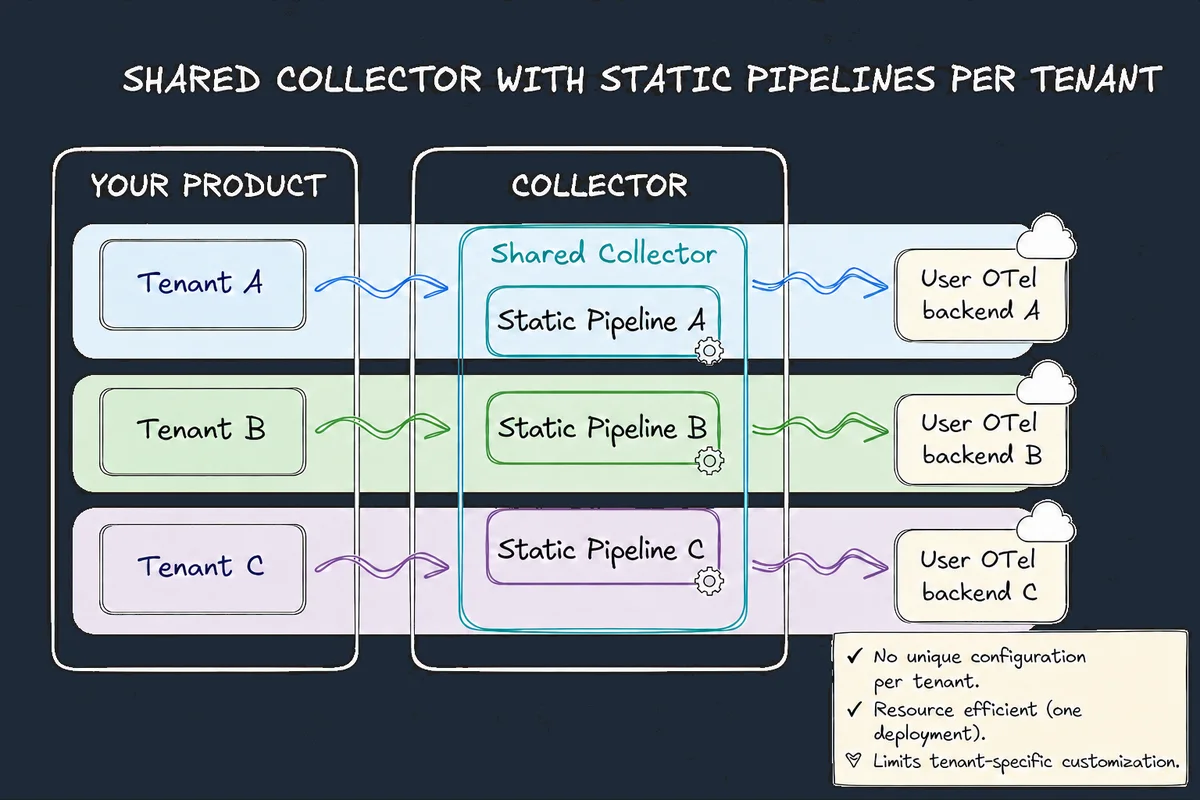
Keeping personal data in China also simplified the legal work. With nothing personal designed to leave the country, the assistant did not rely on any of PIPL's transfer mechanisms, a position counsel reviewed, and the impact assessment could describe a clean boundary rather than a set of exceptions4.
Design the boundary first and the paperwork follows. Bolt on compliance after launch and the paperwork becomes the design.
How it ran
- Channels and use cases
- Chinese evaluation set
- Customer service handover
- Task interface and router
- China region deployment
- In-country telemetry
- Filing route with provider
- Impact assessment
- Data boundary sign-off
- Task-level interface
- Market-aware router
- Prompts as configuration
- Local model and cloud
- Catalogue sync
- In-country telemetry
- Chinese evaluation set
- Safety rule tuning
- Filing documentation
- App first, then mini-programme
- Customer service handover
- Monitoring
Key decisions and trade-offs
| Decision | Alternative | Why |
|---|---|---|
| Task-level interface and router | Fork the product for China | One codebase, features ship to both |
| Locally filed model via a Chinese provider | Use the global model in China | Fits the filing regime and local expectations |
| Personal data stays in China | Central profiles with transfer paperwork | Simpler legal position and lower risk |
| Separate in-country telemetry | Global observability stack | Traces carry personal data; they stay local |
| Chinese evaluation set before launch | Translate the English tests | Quality depends on local language and products |
What I'd do again, and differently
Again: refactor to a task-level interface before building the China region. It turned a risky fork into configuration. Differently: build the Chinese evaluation set with the China customer service team from day one; their real questions were the best test material. Related: model routing, evaluation sets that predict production, consent-aware data in India and where I work.
If you are taking an AI product into China or other markets with their own AI rules, see my AI architecture work, or analyse your challenge and bring the result to a call.
- 1Apple confirms its AI features reach China in December, with QwenThe Next Web · Oct 2026
- 2Interim Measures for the Management of Generative AI ServicesComparativeAI · 2026
- 3Cyberspace Administration's domestic generative AI services filing listDigital Policy Alert · 2026
- 4China's Data Outbound Rules Update: Measures for the CertificationMorgan Lewis · Oct 2025
- 5OTel-Native by Design: Building Products That Export to Any Observability StackOpenTelemetry blog · 8 Oct 2026